Geschiedenis van de TWENOTHistory of the Dutch Armour Association
Geïnspireerd door zijn kennis Fred Vos (de schrijver van de bekende boekjes over pantservoertuigen en tanks in de Kleine Alkenreeks) verenigde de 21-jarige Rob Evers op 1 januari 1968 wat vrienden die de interesse in techniek, geschiedenis en gepantserde voertuigen deelden. Ze noemden zich de Eerste Nederlandse Organisatie van Tankhobbyisten, kortweg de ENOT. Er was geen contributie, geen lidmaatschap en geen bestuur. Rob had een steeds verder uitdijende verzameling foto’s en boeken (900 uiteindelijk), kocht letterlijk alle modellen van militaire voertuigen die te koop waren (Renwal, Aurora, Airfix, Heller, Adams) en was een getalenteerd scratch-bouwer. Daarmee was hij een grote vraagbaak, die met plezier kennis en materiaal deelde. Dit in een periode waar je vooral hoon en spot oogstte als je liet blijken dat je geïnteresseerd was in tanks en het bouwen van schaalmodellen.
Inspired by an acquaintance, Fred Vos (author of Dutch-language books about armoured vehicles and tanks), 21-year-old Rob Evers on 1 January 1968 gathered together some friends who shared his interest in engineering, history and armoured vehicles. They called themselves Eerste Nederlandse Organisatie van Tankhobbyisten (First Netherlands Organisation of Tank-hobbyists
), or ENOT for short. There were no membership dues, no membership as such even, and no board. Rob had an ever-expanding collection of photographs and books (900 eventually), bought literally every model kit of military vehicles available (Renwal, Aurora, Airfix, Heller, Adams) and was a talented scratchbuilder. This made him the great authority, who happily shared his knowledge and materials. This at a time when expressing an interest in tanks and building scale models was mostly met with mockery.
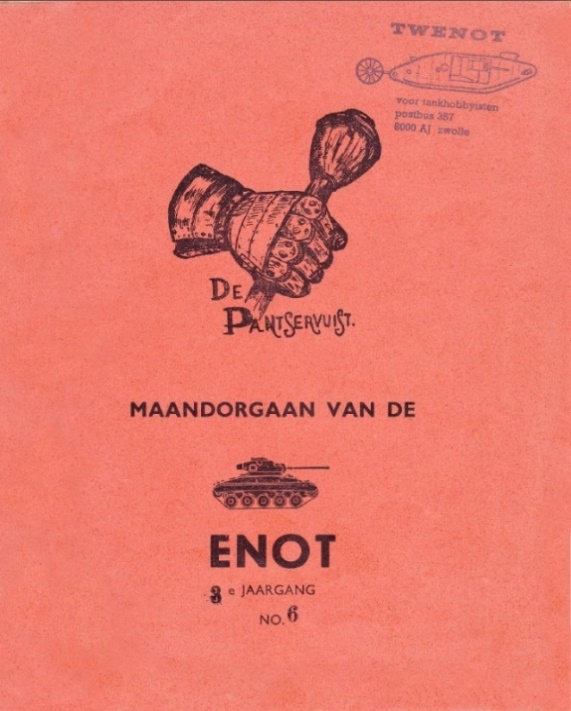
Rob verzorgde naast een fotoservice ook het maandblad, de Pantservuist: acht pagina’s tekst op A5, in een oplage van 25 exemplaren, zonder afbeeldingen en gestencild op een machine van zijn werk. Hij betaalde het uit eigen zak. Informatie over tanks kon je namelijk verder alleen halen uit de Herkenning, een tijdschrift van Defensie dat bedoeld was om de kennis en herkenning van vijandelijk materieel te bevorderen. Ook z’n connecties met de Pantser Herkenningsopleiding op de Bernhardkazerne en met Reyne, de importeur van Tamiya, hielpen hem met het verzamelen van een schat aan materiaal. Ruim acht jaar lang draaide de ENOT op deze wijze. Maar zoals het zo vaak gaat: het gezin en een nieuwe baan eisten hun tijd. Begin 1976 stuurde Rob aan dertig vrienden een brief dat hij er mee wilde stoppen, het werd hem te veel.
In addition to supplying photographs, Rob also put together a montly magazine, Pantservuist: eight pages of text on A5-size paper, with a circulation of 25 copies, without illustrations and printed on a spirit duplicator at the office he worked at. All expenses came out of his own pocket. Information on tanks was really only available otherwise in Herkenning (Recognition
), a magazine published by the Netherlands Ministry of Defence, intended to teach knowledge about and recognition of enemy vehicles. His contacts at the Royal Netherlands Army’s Armour Recognition School and with the Dutch Tamiya importer helped in collecting a wide range of material. For over eight years, ENOT operated in this manner. But as so often happens, his family and a new job began to take up much of Rob’s time. In early 1976, he sent a letter to thirty of his friends to inform them that he was going to call it a day because it was becoming too big a job for him.
In juni 1976 zochten Bert van der Velden en Guus Ebeling Rob op. De twee modelbouwvrienden uit Zwolle vonden het jammer om te stoppen, en kregen de adreslijst van Rob mee. En zo startte op 1 juli 1976 de TWENOT. In die eerste jaren was Bert de man met alle petten
tegelijk op. In 1981 was het eerste contact met een notaris en daarbij ontstond het eerste bestuur:
In June of 1976, Bert van der Velden and Guus Ebeling decided to pay Rob a visit. The two modelling friends from the town of Zwolle didn’t want the society to end, so Rob gave them his address book. And thus, on 1 July 1976, the Dutch Armour Association came into being — its Dutch name being Tweede Nederlandse Organisatie van Tankhobbyisten, Second Netherlands Organisation of Tank-hobbyists
, or TWENOT. In those early years, Bert was the jack-of-all-trades. In 1981, the association contacted a notary as a first step to becoming an official society, which lead to the initial board being created:
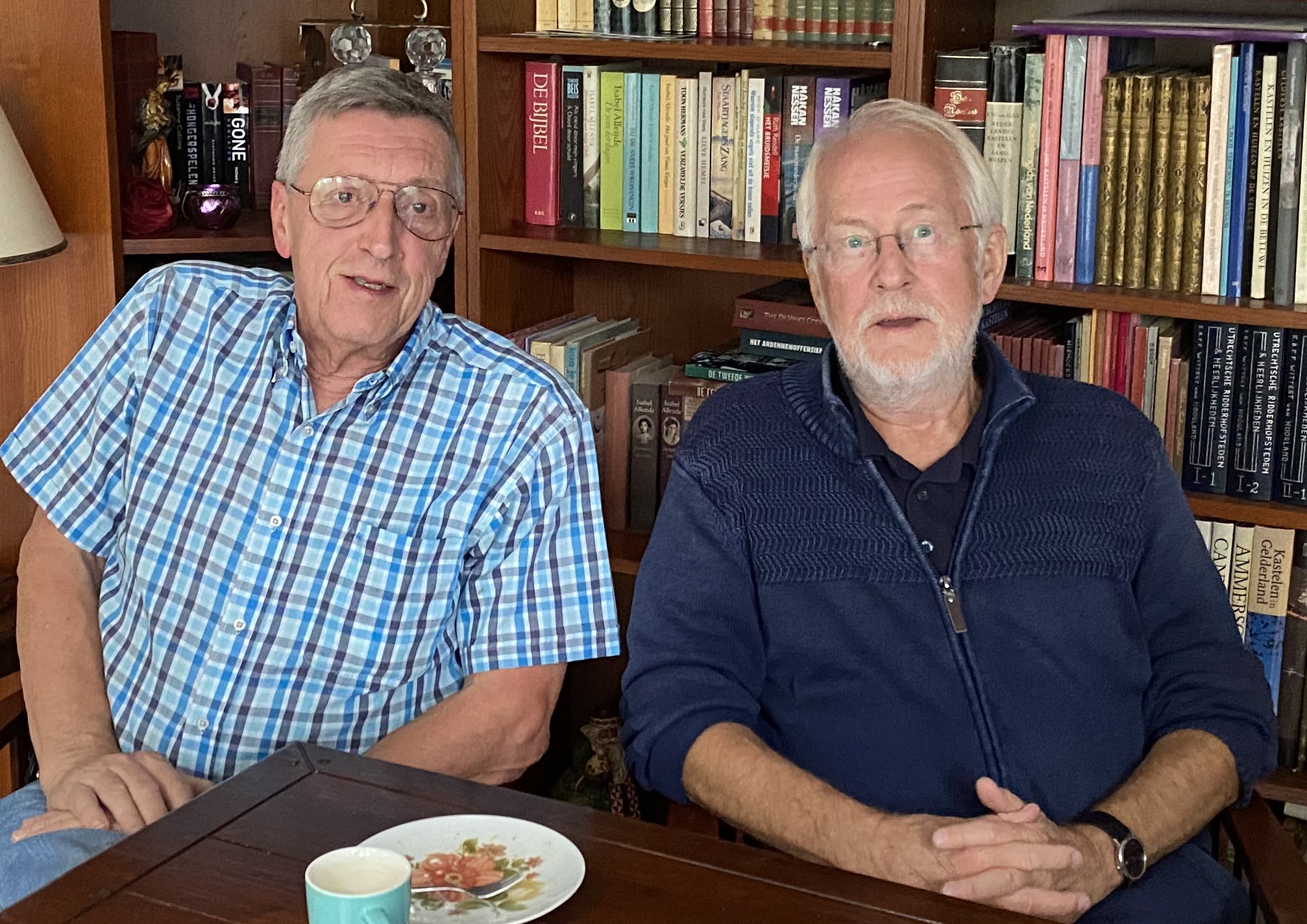
- Rob Evers (nog tien jaar) als voorzitter,
- Bert van der Velden als secretaris,
- Kees Blijleven als penningmeester,
- Ronald Droog voor de jeugdleden,
- John Janse als redacteur en archivaris van de club, en
- Hans Buurman als lid.
- Rob Evers as president (for the next ten years),
- Bert van der Velden as secretary,
- Kees Blijleven as financial officer,
- Ronald Droog for junior members,
- John Janse as editor and the club’s archivist, and
- Hans Buurman as board member.
In februari ’82 werd de TWENOT formeel een vereniging.
In February of ’82, the Dutch Armour Association became an officially registered society.
Al bij de start zijn vijf principes vastgesteld die fundamenteel bleken voor het succes van de TWENOT:
Right at the start, five principles were established that have proven to be fundamental to the association’s success:
- Een lage contributie (ƒ 10,– voor zes nummers van De Tank),
- Wedstrijden, bijvoorbeeld op de houtzolder in Veenendaal of in het buurthuis in Kralingen,
- Een publieksjury van leden en geen vakjury,
- Een gereduceerd tarief en een eigen wedstrijdcategorie voor de jeugdleden, en
- Het bestuur kan geen onkosten declareren.
- Low membership dues (10 Dutch guilders for six issues of De Tank),
- Model contests, for example in the old attic in the town of Veenendaal or in the community hall in Kralingen, Rotterdam,
- Contests judged by all of the members attending the meeting, rather than by an appointed jury,
- Reduced dues and a separate category in contests for junior members, and
- Members of the board cannot claim monetary compensation from the association.
De regio’s werden pas in 1978 uitgevonden.
It would be 1978 before the regions were introduced.
De TWENOT had altijd een fijne onderlinge sfeer. Het was een avontuur, het ging vanzelf, was leuk en het sloeg aan,
bevestigen Bert en Rob. Een journalist, die een van de wedstrijden bezocht, merkte dan ook op: wat prachtig: hier spreken de professor en de stratenmaker elkaar, en ze begrijpen elkaar volkomen.
The atmosphere in the Dutch Armour Association was always a pleasant one. It was an adventure, things just happened, it was fun and it appealed to people,
Bert and Rob confirm. A journalist who visited one of the meetings noted, wonderful: the professor and the bricklayer meet here, and understand each other completely.
De club organiseerde reizen naar Saumur, Brussel en Münster-Lager. Leden vonden elkaar voor diverse museum- en wedstrijdbezoeken door de hele wereld. Na een bezoek aan Walter Kauf, een pionier op het gebied van kleinschalige productie van vacuümgevormde modellen, stuurde die het bestuur een brief met een biljet van tien gulden erbij. Iemand had een model niet afgerekend en met dat geld kan hij ook nog de lijm ervoor kopen.
Het bestuur plaatste de brief in het clubblad en ontving al snel een anonieme excuusbrief, met een passende compensatie voor de diefstal. Ook stonden leden drie keer in Utrecht op de beurs Techniek & Vrije Tijd. In 1981 leverde dat 45 nieuwe leden op, waarvan er in 2021 nog zeven lid waren. Daarbij had men trouwens wél zes stevige knuppels onder de tafel liggen, want men vreesde een bezoek van de antimilitaristische actiegroep AMOK aan de TWENOT-stand.
The association organised excursions to Saumur, Brussels and Münster-Lager. Members got together to visit various museums and contests all over the world. After a visit to Walter Kauf, a pioneer in the field of producing vacuum-formed models, he sent the society a letter that included a ten-guilder note. Somebody had neglected to pay for a kit and with the money, he can buy a tube of glue for it too.
The letter was published in the club magazine and the association soon received an anonymous letter of apology, including compensation for the theft. Members also attended the Techniek & Vrije Tijd (“Engineering & Spare Time”) show in the city of Utrecht on three occasions. In 1981, this resulted in 45 new members, of whom seven still were in 2021. However, underneath the table they kept six stout sticks because of a fear that a notorious anti-militaristic group might pay a visit to the Dutch Armour Association’s stand.
Onze hobby ontwikkelt zich nog altijd. Een zakje Airfix kostte toen ƒ 1,50 (€ 5,30 in 2025, gecorrigeerd voor inflatie). Het topmodel dat Rob toen kocht, Atomic Annie van Renwal, kostte ƒ 16,50 (€58 in 2025). Als jouw modelbouwwinkel het niet had, moest je wachten of iets nieuws verzinnen. Tegenwoordig hebben we resin, etch, 3D-printing, airbrush, Internet research, online fotoarchieven, ebay en Marktplaats. De wereld is onze winkel én onze inspiratie. Onveranderd zijn onze gemeenschappelijke interesse en de kameraadschappelijke sfeer in de club. Het is dan ook geen wonder dat de TWENOT inmiddels meer dan 700 leden heeft en groeit. Vele Tanks verder is het blad gegroeid naar 32 pagina’s A4 in fullcolour. Het forum heeft veel actieve bezoekers. Leden en niet-leden treffen elkaar daar dagelijks, delen informatie en moedigen elkaar aan.
Our hobby is still developing. A bagged Airfix kit back then cost 1.50 guilders (around € 5.30/£ 4.40/US$ 5.40 in 2025 money, adjusted for inflation). Rob’s prize model, Atomic Annie by Renwal, cost 16.50 guilders (around € 58/£ 48/US$ 60 in 2025). If your local model store didn’t have something you wanted, you would have to wait or come up with an alternative. These days, we have resin, photo-etch, 3D printing, airbrushes, Internet research, online photo archives and ebay. The world is our model store and our inspiration. Unchanged are our common interest and the friendly atmosphere in the club. It’s no surprise that the Dutch Armour Association has over 700 members and is still growing. Over many issues of De Tank, the magazine has grown to 32 pages at A4 size in full colour. The forum has many active visitors. Both members and non-members meet there daily, sharing information and encouraging each other.
Eén punt staat voor ons voorop, namelijk de mogelijkheid dat tankhobbyisten elkaar kunnen vinden,
schreef de redactie in De Tank nummer 1. Die opzet is — met de inzet van velen — geslaagd.
One thing stands above everything else, namely the possibility for tank hobbyists to find each other,
the editor wrote in De Tank issue 1. That goal has — through the efforts of many — been reached.